
by Ed Lallo/Gulf Seafood News Editor
High heels and wingtips clicking and clacking through the
marble halls of Congress, a constant buzz of voices bouncing off Gulf Senators
and Representatives office walls, hands continuously pressing the flesh and
passing paper after paper; these are the sights and sounds of the Gulf Seafood Institute’s (GSI)
second annual “Walk on the Hill” in the nation’s Capitol.
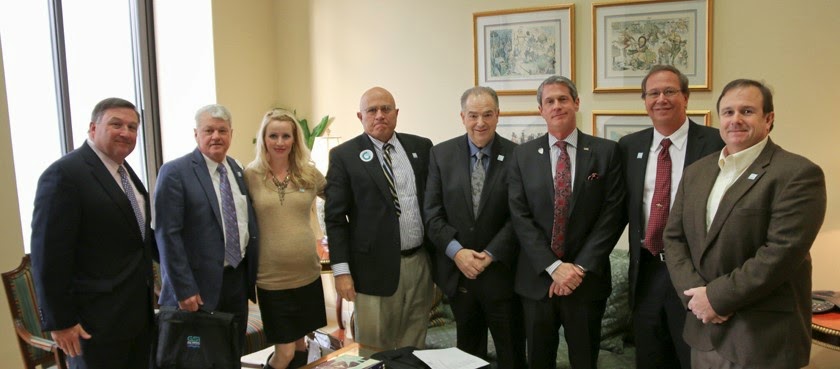 |
Members
of the Gulf Seafood Institute visit with
La. Senator David Vitter in his
D.C. office. GSI members
represent seafood interests in all five Gulf States.
(L-R) Stan Harris of the La. Restaurant Assoc.,
Harlon Pearce of
Harlon’s LA Fish, GSI Executive Director
Margaret Henderson, seafood processor
Frank Randol,
Jim Gossen who is chairman of Sysco Louisiana Seafood,
Senator
David Vitter, David Krebs of Arial Seafoods
and charter boat Captain Troy
Frady.
|
“The Gulf Seafood Institute meets regularly with Congressmen
and staff, as well as various executive agencies and non-governmental
organizations, to educate them on the needs and concerns of the Gulf’s diverse
seafood communities,” said GSI’s executive director Margaret Henderson while
walking a hallway of the Longworth building. “This annual event gives us the
opportunity to communicate face-to-face issues facing Gulf seafood. It is
important to every fisherman, processor, distributor, chef and restaurateur in
the five Gulf States to have those representing us in Washington knowledgeable
on the effects of legislation they initiate.”
According to Henderson, GSI has led the way in uniting the
various Gulf groups and giving them a voice they have never had before. The
politics of seafood crosses many boundaries: federal, state, local and private.
The organization’s walk on Capitol Hill is one of its many programs to keep
legislators and government officials aware of the needs of the Gulf’s various
fishing communities.
“We have access to some of the greatest seafood in the world
and we want to keep that access open to both commercial and recreational
fishermen,” said Harlon Pearce owner of Harlon’s
LA Fish and president of GSI’s board. “These meetings are designed to
show those creating the politics of seafood how important it is to have proper
and effective legislation and programs in place.”
Important Issues
In a prepared packet hand delivered to each office, GSI has
outline three important issues immediately important for Gulf of Mexico
seafood:
Proposed Gulf of
Mexico Oyster Mega-Hatcheries
Extended drought conditions in the Gulf States, along with
poor water quality, eroding coastlines, Gulf dead zones and the consequences of
the Deepwater Horizon spill on living
marine resources such as oysters, have created a unique
opportunity to rethink
how
the Gulf of Mexico oyster habitat is created and restored. The aim of two
proposed Gulf of Mexico oyster mega hatcheries is to enhance the public stock
oyster reefs in all five Gulf States, as well as create new habitat resulting
in a cleaner Gulf.
NMFS Implementation
of Electronic Data Collection for Charter For Hire Sector
According to NOAA, the Gulf charter-for-hire and private
angler components of the recreational sector support 460,000 angler trips
targeting and catching red snapper in the Gulf of Mexico annually. The fishery
directly supports 759 jobs, generates $113 million in business sales and
contributes $64 million to the national economy. It is an extremely important
economic driver for the region, but must be managed carefully to ensure
longevity of the species, and the communities and businesses that depend on it.
Currently, management of the recreational red snapper sector
in the Gulf is in turmoil. Based on the “best available science” and data from
the Marine Recreational Information Program (MRIP), fishery managers have
shortened the recreational red snapper season length drastically in recent
years, culminating in a 9-day season in 2014. Real-time data is critical to
better understand the status of the fishery and provide fishery managers with
adequate tools to make the best decisions for the resource and fishermen.
Congress is urged to communicate with the National Oceanic
and Atmospheric Administration (NOAA) directing them to utilize recently
appropriated funds to roll out a robust electronic data collection program in
Gulf of Mexico charter community in time for the 2015 red snapper season this
June.
H2B Migrant Worker
Legislation
Seafood processors along the Gulf coast rely on temporary,
seasonal foreign workers admitted to the U.S. under the H-2B Visa program to
fill the most labor-intensive positions in the industry. The work done by these
skilled laborers is necessary to support thousands of seafood jobs held by U.S.
workers. Because of the unique nature of the seafood occupation and the rural
location of many processors, the seafood industry has used Private Wage Surveys
for more than 15 years to set their wage rate, often relying on State
agency-provided wage surveys.
In December of 2014, the Department of Labor announced they
would no longer accept PWS in determining wages for H-2B visa workers.
Current Department of Labor rules governing this program
threaten the viability of various Gulf seafood communities that rely on
temporary, foreign H-2B visa workers. These workers in oyster, crawfish and
crab processing fill jobs that American workers refuse to do.
Congress should sign a letter to Labor Secretary Perez and
support language in FY 2016 appropriations bills directing the DOL to continue
accepting private wage surveys for H-2B visa workers in the seafood industry.
